

0
+
For generations, Lechtlhof has been run as a traditional mountain farm. Livestock farming and hay harvesting formed the foundation of the family’s livelihood.
Over time, technical innovations and changing economic conditions transformed daily work – yet the character of the farm remained unchanged.
In more recent years, holiday apartments were added to ensure the farm continues to thrive.
Today, Lechtlhof combines agriculture and hospitality as equal parts of farm life.
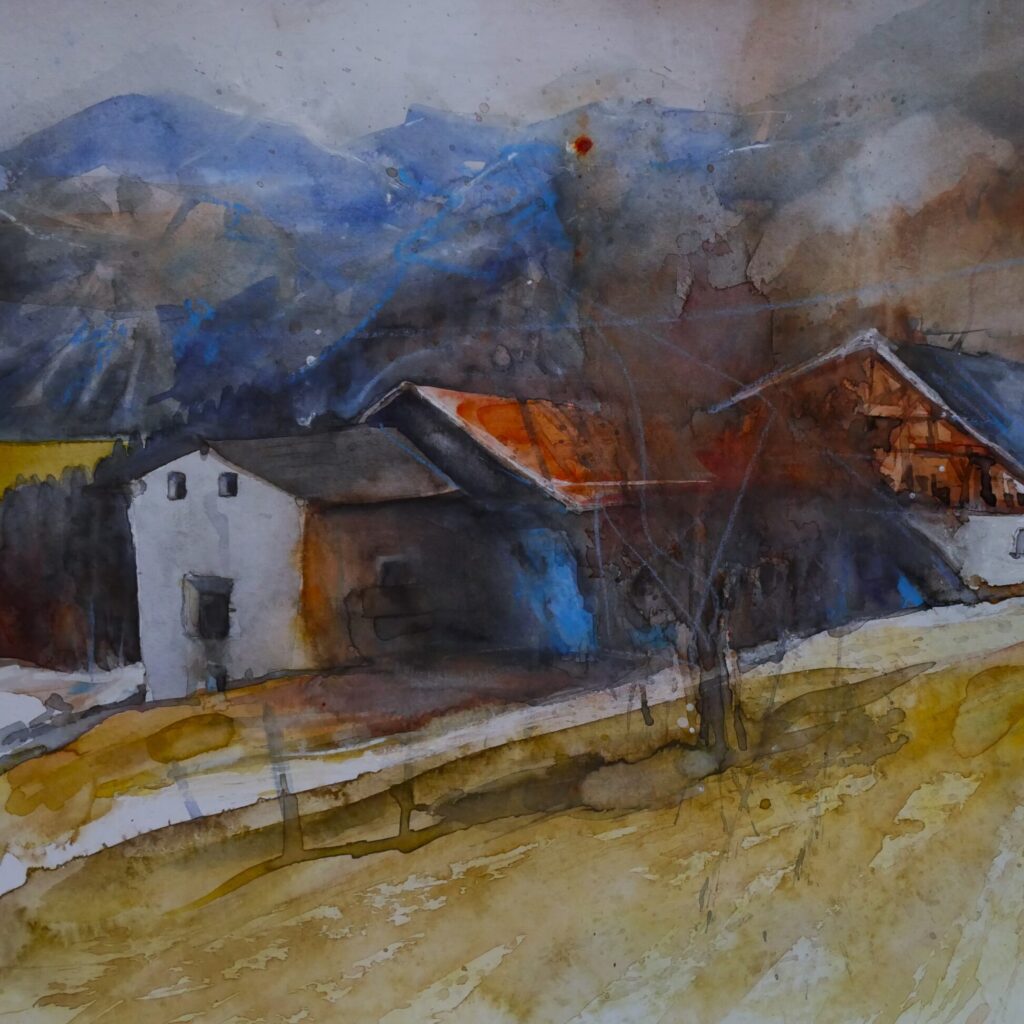
The special significance of Lechtlhof is reflected in the ensemble of farmhouse, Lechtl Chapel and the old forge. The chapel, dedicated to “Maria Empfängnis,” is a listed historic monument and dates back to the mid-17th century. In the 1850s, it was expanded to its present size.
The forge is no longer in operation. Where iron was once worked, guests now find a cosy gathering space – the old mill of the farm is also on display here.
At the foot of Lechtlhof lies the Tartscher Bühel with the Romanesque Church of St. Veit, offering wide views across the valley from both the farm and the chapel.
The history of Lechtlhof can be traced back to the 14th century. The first known written record dates from 1375, in a register of property rights belonging to the Lords of Matsch, where the farm was still referred to by its Rhaeto-Romanic name, “Munterschinig in Val.” The document also lists the obligations of the respective tenant farmers.
Around 1580, Lechtlhof appears on a map in connection with a grazing dispute between the communities of Tartsch and Mals. A major turning point came in 1799, when French soldiers burned down the farm. In 1926, Lechtlhof finally became the property of the family of its current owners.
The name of Lechtlhof has changed several times over the centuries. In a register of the Lords of Matsch from 1375, the farm is still referred to as “Munterschinig in Val.” Around 1580, it appears under the names “Lechtal” or “Pfalz.”
Linguists such as Karl Finsterwalder and Egon Kühebacher trace the present-day farm name “Lechtl” to a derivation of the origin name “Lechtaler,” referring to people from the Lechtal valley. Archival research shows that as early as the 16th century, the farm was already referred to as “Lechtallerhof,” “Lechtal,” or “Pfalz.”
A court record from 1521, for example, mentions a “Martin Lechtaller of Lechtallerhof.” Whether the farm name was derived from the family name or vice versa can no longer be determined with certainty.
It is believed that the widely spread Vinschgau family name “Theiner” derives from the local word “Thein,” referring to a strip of field or farmland between two paths or irrigation channels. Even at Lechtlhof, the highest field is still known today as “Holzthein.”
Waale are man-made irrigation channels that carry water from mountain streams to fields, often located far away. Due to the low rainfall in the Vinschgau, one of the most extensive irrigation systems in the Alps developed here.
Lechtlhof was irrigated by Waale well into the early 2000s; until the 19th century, a dedicated farmhand was even employed solely to maintain them.
In June 2015, Gernot Niederfriniger, chairman of the South Tyrolean Folk Music Association, composed the “Lechtl March” and dedicated it to our family. From his kitchen window, he looks directly onto Lechtlhof – which likely inspired the piece.
The premiere took place in the traditional farmhouse parlor of Lechtlhof, where Gernot performed the piece together with his ensemble “Storchenmusig.” Since then, the “Lechtl March” has become a regular part of their repertoire and is performed on various occasions.
We use cookies and similar technologies to provide you with a smooth and comfortable browsing experience. With your consent, we process anonymous usage data to improve our website. Without consent, some features may be limited.